The Athens issue
The Athenian Street Counter: Souvlaki, Koulouri and the City's Real Midnight Kitchen
Where Athens actually eats after dark — a plate-by-plate guide to the souvlaki holes, pie shops and market tavernas that never let you go hungry.
By Marta SolàEating through Athens, from Varvakios market stalls to Koukaki tavernas

There is a particular hour in Athens — somewhere past midnight, when the marble of the Acropolis has gone cold and the bars have spilled onto the pavements — when the whole city seems to be holding a paper-wrapped skewer. Charcoal smoke drifts off Agia Irini square, a queue folds around a pie shop that has been open since before either World War, and someone is eating a honey-drenched doughnut standing up because there is nowhere left to sit. This is the real Athenian kitchen: not the white-tablecloth taverna, but the counter, the wrap, the grab-and-go bite. I have eaten my way through it more than twice over — the only way I write about anywhere — and here is where I keep going back.
The classic souvlaki: where the city started

Souvlaki is the anchor, and you should treat the old guard with respect before you go chasing the reinventions. Start with Kostas (Agia Irini), a seventy-year family institution and, for a great many locals, simply the best wrap in the centre. Do not arrive expecting a table — there is essentially no seating, it is takeaway only, and the drill is to grab your wrap and eat it on the church steps opposite with everyone else. At around €3–4 a souvlaki, it is almost absurdly cheap for what it delivers. One warning that trips up visitors constantly: Kostas closes on weekday afternoons the moment it sells out, so this is a mid-morning or early-lunch pilgrimage, not a plan-B for later. Go early, or go disappointed.
If you are moving as a group, the old guard has you covered too, just a few minutes away in Monastiraki. O Thanasis (Monastiraki) has been grilling since the 1960s and is built for exactly this — a big taverna with masses of outdoor seating that swallows walk-in groups without fuss. The signature here is not plain gyro but a spiced, ground-lamb kebab, fragrant with cumin and served on warm pita; plates land around €10–13. Yes, the square is touristy. No, that does not stop the food from being genuinely good.


Next door in every sense is Bairaktaris (Monastiraki), the 1879-founded landmark whose walls are papered with photographs of every politician and celebrity who ever passed through. I will be honest with you, as I always am about the door: this is the most frankly touristy of the three, a sprawl of outdoor tables engineered for tour parties, and you come for the atmosphere and the history more than for culinary purity. Plates run the same €10–13. If you have one souvlaki meal in you and you want the best food, choose Kostas or O Thanasis; if you want the noise, the crowd and the sense of theatre with a big group, Bairaktaris earns its place.
Plan your Athens trip
Live prices from our booking partners.
Free cancellation on many rooms. We may earn a commission when you book.
The new wave: chefs at the charcoal
Something genuinely interesting has happened to souvlaki in the last few years — proper chefs have taken it seriously, and the results are worth the modest step up in price. The modern benchmark sits right on the lively Agia Irini square: Hoocut (Agia Irini), a five-chef collaboration that rebuilt the wrap from the pita up, baking their own and using premium mutton and beef. The format is a casual counter with some tables; a couple or a small group will be comfortable, but a large party may need to split across tables, so manage expectations. Wraps land around €4–6, which for this quality is still street-food money.

For the most precise plate of the new school, find Kapsa by Peskias (central), where the Cypriot chef Christoforos Peskias brings fine-dining discipline to a skewer. The pork neck is brined for twelve hours and grilled over charcoal until it is smoky at the edge and still yielding inside — one of the city's newest must-tries, at roughly €4–6 a wrap. It is a compact spot, ideal for two or a small huddle of friends and tight for a big booking; don't roll up eight-strong and expect to sit together.

If you want the new-wave idea in restaurant form — actual seating, indoors and out, and no anxiety about where the group will go — walk east to Meat n' Roses (Pangrati). This is a polished take on souvlaki with premium meats and plates around €10–15, a real step up in price and comfort from the classic joints. I like it as a lunch when I am already circling Kallimarmaro and the Zappeion gardens; you can eat well, take a table for a proper booking, and stroll it off among the monuments afterwards.

The real midnight kitchen: eating after the bars

Here is where Athens shows its true character. The city does not stop feeding you when the kitchens elsewhere close — it just moves the counter. Out in the gritty-cool west of the centre is Elvis (west-central), a cult skewer joint that stays open into the small hours and is the go-to for a smoky, restorative wrap after a night out. It is small and buzzy, better suited to a handful of friends than a big organised booking, and the souvlaki sits around €3–4. Do not overthink it: you will be eating standing up, slightly deafened, and perfectly happy.
Up in Exarchia, the anarchic student heart of the city, Kavouras (Exarchia) has been at it since 1969 and stays open until roughly 3am. The gyro is solid and cheap at €3–4, but the reason to climb the stairs is the live rebetiko upstairs — the smoky, bittersweet urban blues of Greece. Groups pile in here, especially after a gig, and the atmosphere is as much of the meal as the food. It is loud, it is late, it is unpretentious, and it is one of the most Athenian rooms you can eat in.

One honest note on both: these are neighbourhoods with edge rather than polish, particularly Exarchia. That is precisely the appeal, and both places are institutions rather than dives, but go with the easy confidence you would bring to any late night in a big city and you will be fine.
Beyond the skewer: pies, pastry and a Middle Eastern detour
Athens on foot is a city of small, specialist counters, and to eat only souvlaki is to miss half the point. For a cheap, distinctive swerve, find Feyrouz (central), a minuscule family-run spot with Antioch and Armenian roots turning out excellent lahmacun and peinirli — including genuinely good vegan options, which are not always easy to find on this trail. There are a couple of stools and no more; treat it as grab-and-go for a group rather than a sit-down, at €2.50–4 a wrap. It is the sort of tiny place you would walk straight past, and exactly the sort I send people to.

For the single most Athenian breakfast or between-meal bite, there is Ariston (central, near Syntagma), the city's oldest pie shop, open since 1910. It is pure takeaway, no seating — which makes it perfect for a walking group, buying an armful of pies to hand round. The signature is the kourou-crust feta tiropita, buttery and short and warm from the case, and there are more than a hundred regional pies alongside it, most in the €2–3 range. If you buy one pie in Athens, buy it here.
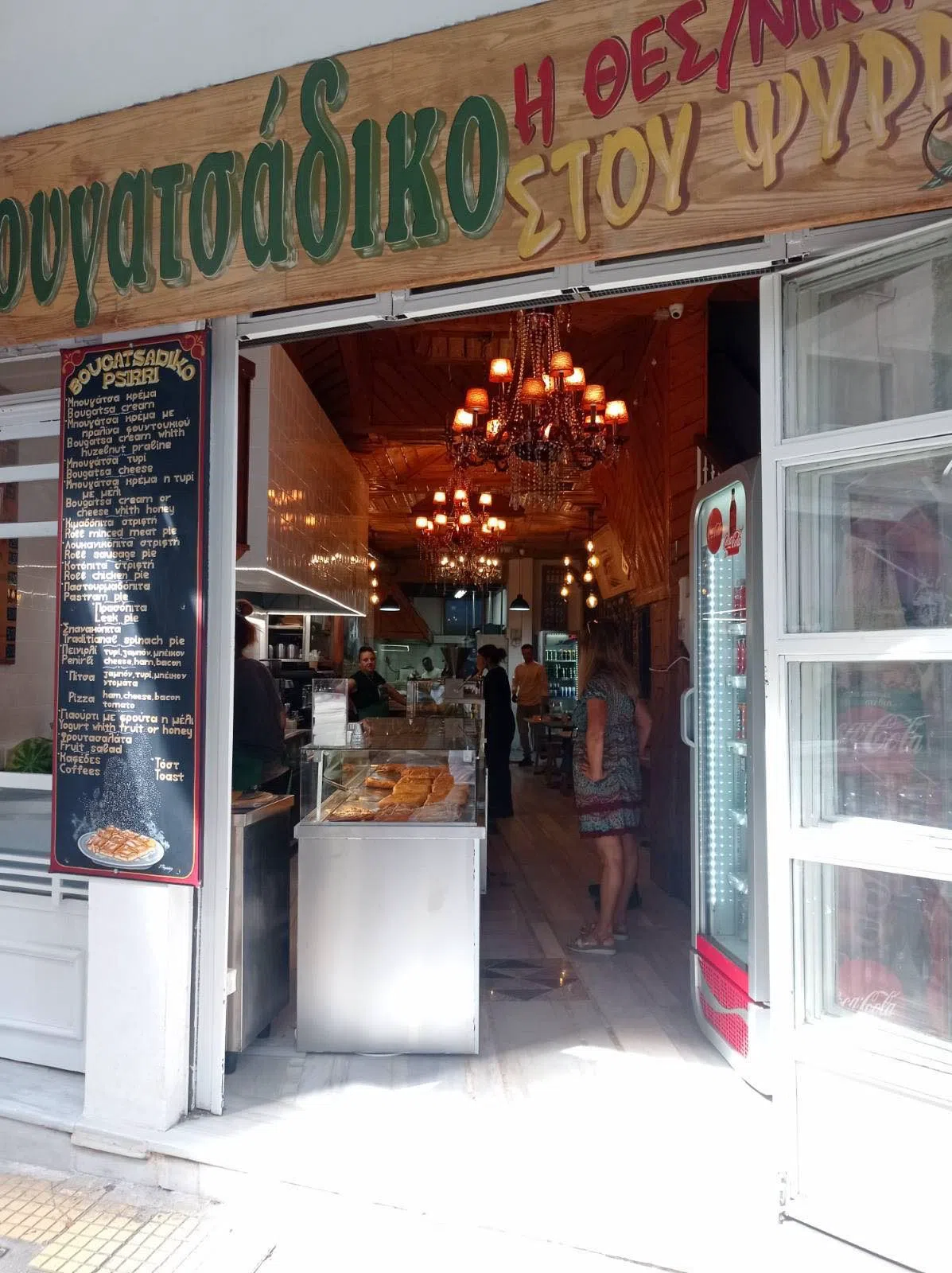
When you want something sweet and want to sit for a moment, two counters stand apart. Krinos (central) has been frying the city's most iconic loukoumades since 1923 — the honey-soaked Greek doughnut, dusted with cinnamon, essentially unchanged for a century. It is old-school café seating, compact but real, and a plate of six runs about €3.50–5; a group can sit in for a round. And for phyllo done the traditional way, Bougatsadiko Thessaloniki (Psyrri) is one of the very few places where you can actually watch the pastry hand-pulled to a translucent sheet before it is folded around sweet custard or savoury minced meat. It is a sit-down café-bakery on the square, it comfortably takes groups, and — crucially for this guide — it stays open into the early hours, a portion running €3–5. When the souvlaki queues are impossible at 2am, this is where I go instead.

For groups who want to sit down properly
Much of this trail is pavement food, eaten upright. But two places are built for the meal where everyone actually sits, orders and shares, and both cluster around the Central Market. Ta Karamanlidika tou Fani (by the Central Market) is a deli-taverna genuinely set up for groups: boards of cured meat and cheese drawn from Anatolian traditions, ordered to share, at €€–€€€ depending on how greedy the table gets. It is not street food and does not pretend to be — it is the ideal group sit-down on this route, and for a larger party it is sensible to book.

And then there is the beating heart of it all: Varvakios Agora (Central Market), the Athens central market, feeding the city since 1886. This is a sensory group experience before it is a meal — wander the halls of hanging meat and glittering fish, and then pile into one of the market tavernas, the patsatzidika, for cheap, honest plates amid the din. Go mid-morning for the full spectacle, and note that it is closed on Sundays, which catches out more visitors than you would think. Come as much for the theatre as for the eating; both are excellent.

Planning your Athens counter crawl
A few practical notes to make the trail run smoothly, whether you are here for a weekend or building it into a longer stay. For a base, keep it central: the whole classic-souvlaki cluster around Monastiraki and Agia Irini is walkable, and the market, Psyrri and Syntagma counters all fold into the same loop — start your Athens hotel search somewhere in that ring and you can do most of this on foot. For everything else the neighbourhoods hold, the wider Athens guide is worth a read before you arrive.
Getting around. The metro is clean, cheap and fast, and Monastiraki, Syntagma and Omonoia stations put you within a short walk of nearly everything here. Most of the day-trail — Kostas, the market, the pie and pastry shops — is comfortably covered on foot. The late-night stops out west and up in Exarchia are a short taxi or a brisk walk; at 2am a taxi is the easy call.
Cash. Carry some. The best of these places are tiny, family-run and cash-first — the wrap counters, Feyrouz, Ariston, Krinos in particular. The bigger tavernas and the newer chef spots will take a card, but you do not want to be the person holding up the Kostas queue over a €3 souvlaki.
Timing. Build the day around two facts: Kostas closes weekday afternoons once it sells out, so hit it early; and the market is best mid-morning and shut on Sundays. Save Elvis, Kavouras and Bougatsadiko Thessaloniki for the late slot — they are at their best after midnight, and Bougatsadiko is your safety net when the souvlaki lines are hopeless.
Budget. This is some of the best-value eating in Europe. A classic souvlaki is €3–4, a pie or a lahmacun €2–4, a plate of loukoumades under €5. The chef-driven wraps at Hoocut and Kapsa run €4–6; the sit-down plates at O Thanasis, Bairaktaris and Meat n' Roses land €10–15; and a shared meze board at Ta Karamanlidika is where you might actually spend, and gladly. You can eat superbly here for the price of a couple of coffees back home — and, plate for plate, honestly better than most cities twice as expensive.
Who it suits. Couples and pairs should chase the small, buzzy counters — Kostas, Kapsa, Elvis, Feyrouz. Big groups want O Thanasis, Bairaktaris, Meat n' Roses, Bougatsadiko and Ta Karamanlidika, all of which take a crowd (book the last two if you are many). And whoever you are with, leave room, walk between stops, and let the city feed you the way it feeds itself — one warm, paper-wrapped bite at a time.
Before you go
Where is the best souvlaki in central Athens?
For many locals it's Kostas on Agia Irini square — a seventy-year family institution with wraps around €3–4. It's takeaway only with no seating, and it closes on weekday afternoons once it sells out, so go early. For a sit-down group meal, O Thanasis in Monastiraki (spiced lamb kebab, plates €10–13) is the reliable classic.
Which Athens souvlaki places are open late at night?
Elvis in the west of the centre and Kavouras in Exarchia (open until roughly 3am, with live rebetiko upstairs) are the classic post-night-out grills, both with souvlaki around €3–4. For phyllo pastry into the early hours, Bougatsadiko Thessaloniki in Psyrri stays open late and takes groups comfortably.
How much does street food cost in Athens?
It's some of the best value in Europe. A classic souvlaki is €3–4, a pie or lahmacun €2–4, and a plate of loukoumades under €5. Chef-driven wraps at Hoocut and Kapsa by Peskias run €4–6, while sit-down plates at the bigger tavernas land around €10–15.
Which Athens counters work for a large group?
O Thanasis and Bairaktaris in Monastiraki are big tavernas built for tour parties, and Meat n' Roses in Pangrati has proper indoor and outdoor seating. For a sit-down sharing meal, Ta Karamanlidika tou Fani by the Central Market is set up for groups — book ahead for larger parties. Tiny spots like Kostas, Kapsa and Feyrouz suit couples or a few friends better.
Do Athens street food places take cards, and when are they open?
Carry cash — the best small, family-run counters (Kostas, Feyrouz, Ariston, Krinos) are often cash-first, though bigger tavernas and newer spots take cards. On timing, hit Kostas early before it sells out, and note the Varvakios Central Market is best mid-morning and closed on Sundays.