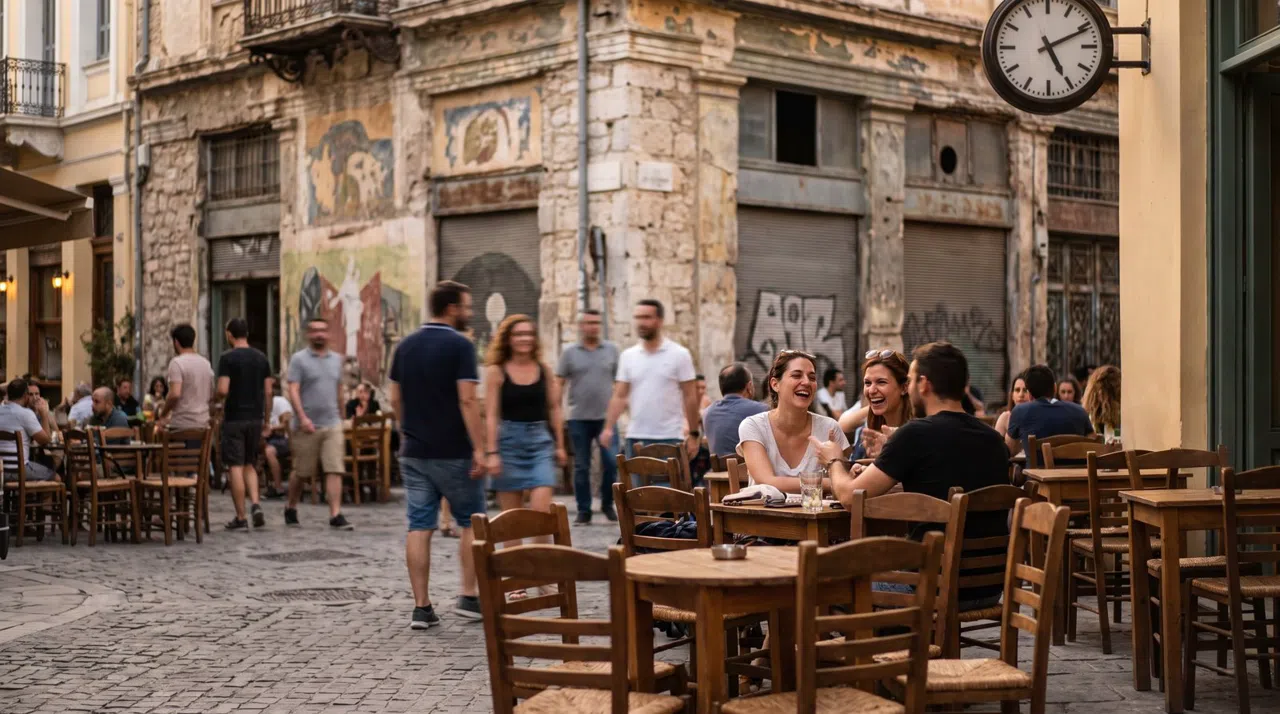
A ten-minute walk north of Monastiraki station, Psirri begins to feel like a city changing its mind in public. One lane holds a cobbler’s shopfront; the next, a natural-wine bar; then a mezedopoleio where pastirma can still arrive after midnight. This was once Athens’ tanning-and-ironmongery quarter, and the old working life has not vanished so much as been overpainted, re-rhymed and pushed into the evening. By day it can look half-asleep. By night it finds its pulse in Plateia Iroon, where tables, gelato queues and cocktail drinkers spill into one another until very late.
What Psirri is known for
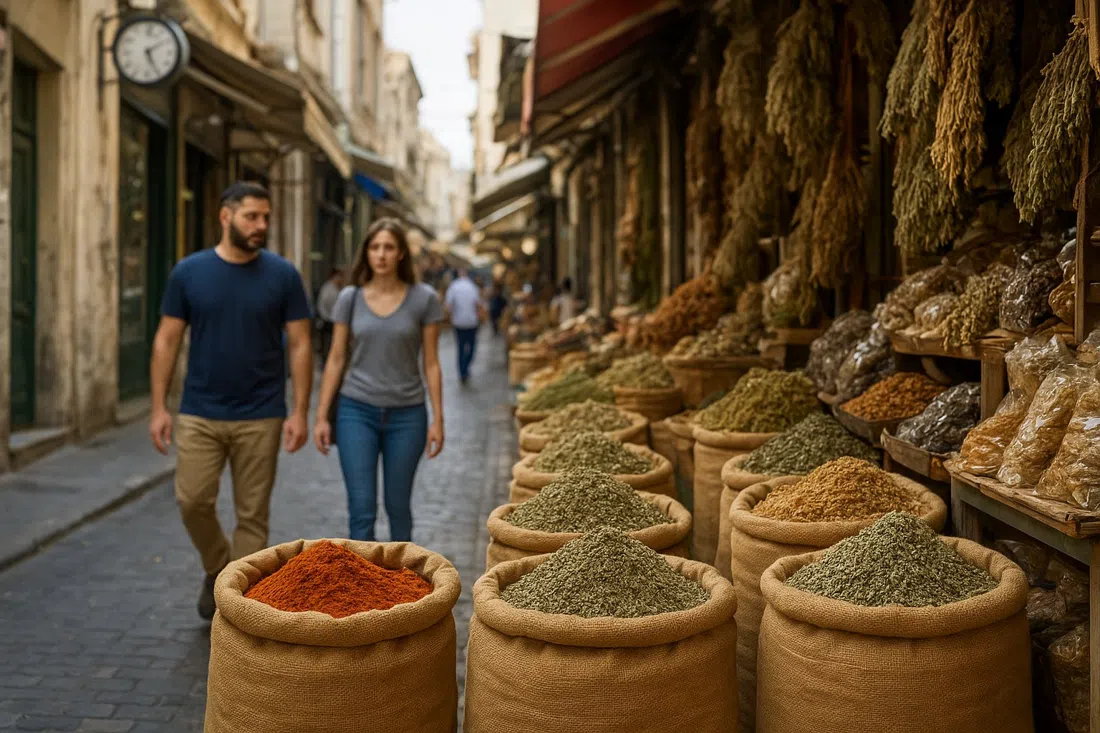
Psirri’s great trick is that it never fully became the polished version of itself. It was a workshop district first — tanners, cobblers, ironmongers, rope-makers — and the trade logic still runs through the streets if you know where to look. On Athinas, leather and hardware shops still hold the line, and on Evripidou the air can still smell like a market: dried herbs, chillies, cured goods, sacks stacked outside the door. Then the bars arrived, and the tavernas, and the paint. The result is a neighbourhood that feels assembled rather than designed, which is exactly why it works.
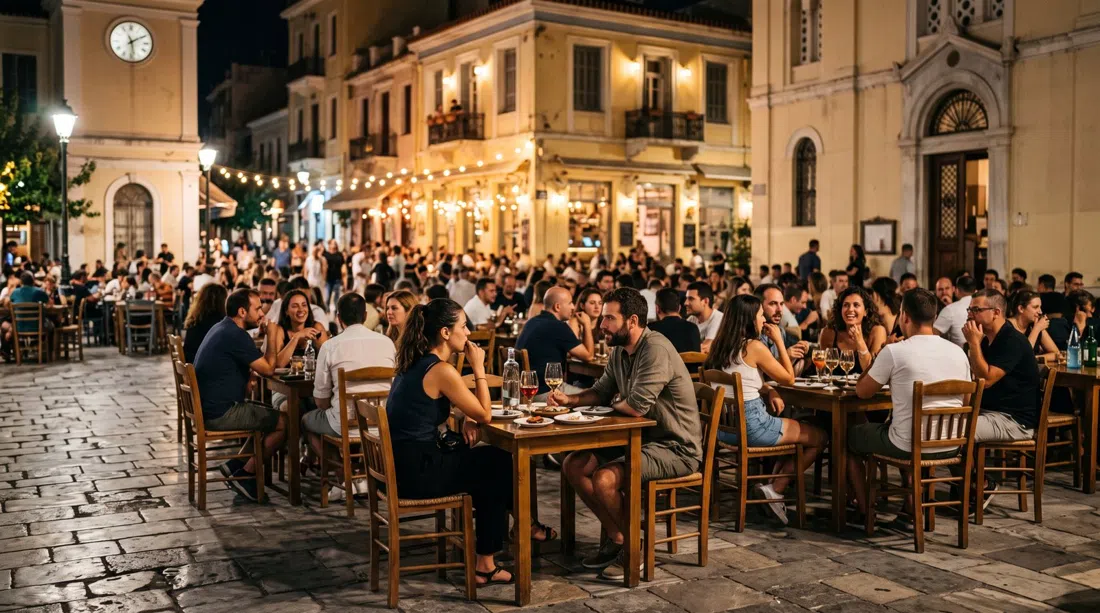
The centre of gravity is Plateia Iroon, Heroes’ Square, and it’s here that Psirri reveals its social grammar. In the early evening the square is a spillway of Athens life: taverna tables, gelato queues, people standing with drinks while deciding where to sit and whether to stay. By 11pm it becomes an argument between music and conversation, and by the small hours the lanes off it are carrying the noise rather than containing it. The district’s murals are part of that atmosphere, too. Some are commissioned, some not; all of them seem to shift the mood of the walls from month to month.
The whole quarter is compact, bounded roughly by Ermou, Athinas, Evripidou and Peiraios, which means Psirri rewards wandering more than planning. The pleasure is in the short distances: from a spice shop to a wine bar, from a deli counter to a rebetiko room, from a painted wall to a tray of slow-cooked food. It is more lived-in than curated, and that is the point.
Where to eat & drink
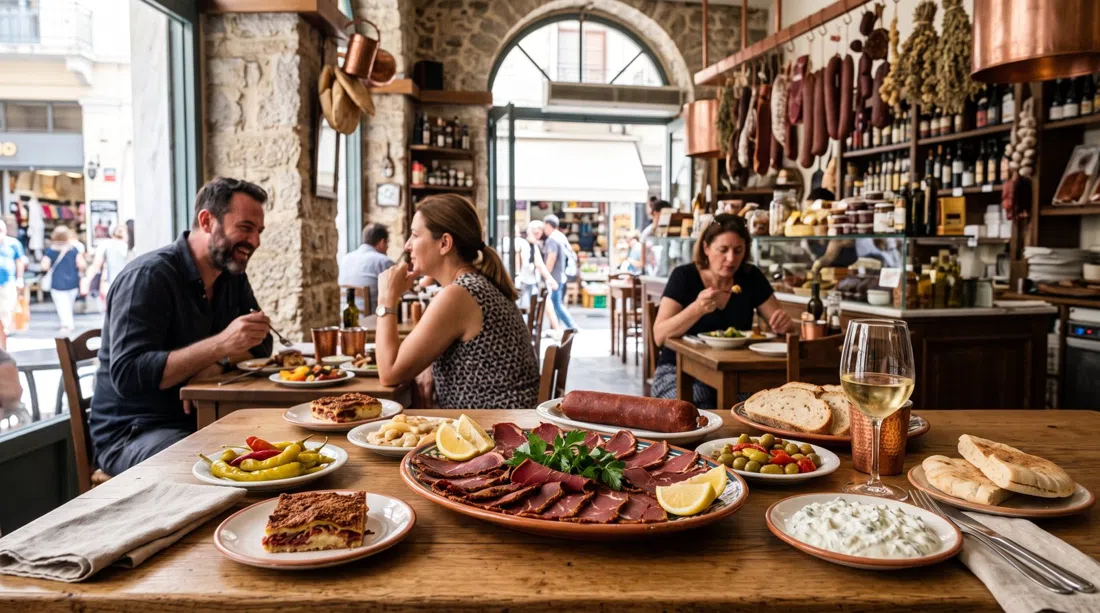
If Psirri has an anchor, it is Ta Karamanlidika tou Fani on Evripidou, a half-deli, half-mezedopoleio rooted in the tradition of the Karamanlides, the Anatolian Greeks displaced in 1923. This is the place to begin because it tells you exactly what kind of neighbourhood you are in: one where memory is edible. The house-cured pastirma is the signature order, best alongside cheeses and a spread of small plates that will run roughly €20–25 a head with a beer or tsipouro. It is generous food, but not loud about it.
A few streets away, Nikitas at 19 Agion Anargyron has been feeding Psirri since 1967 and still feels like the kind of taverna that outlasts trends by simply staying itself. It is probably the oldest kitchen still standing here, and the draw is fresh, cheap, honest Greek cooking, with stuffed vine leaves singled out for good reason. Outdoor tables fill quickly at lunch, which tells you everything you need to know about how locals use it.
For the old-school tray-cooked rhythm of the neighbourhood, Taverna tou Psyrri on Iroon Square does mayirefta — the ready-in-the-tray dishes that make lunch feel like a domestic act rather than a performance. Moussaka and stews sit where they should, and the square outside keeps moving around them. Krasopoulio tou Kokkora is the family music-taverna version of the same instinct: barrel wine, homemade daily plates, and the possibility that dinner may drift into rebetiko whether you planned for it or not. This is where Psirri’s after-dark identity and its older working-class soul meet each other without embarrassment.
Seafood arrives in cheerful, unfussy form at Atlantikos, a psarotaverna built for grilled fish and octopus rather than ceremony. It is the sort of place that keeps the neighbourhood from becoming too meat-and-meze in its own imagination. On the more polished side, Taverna Ermou at 98 Ermou — the Ergon group’s restored-building address on the quarter’s edge — offers a modern read on the taverna idea, with small-producer sourcing, slow-cooked meats, bean stews and pies. It feels more composed, but still recognisably part of the same food map.
For drinks that lean quieter and more deliberate, Cinque Wine & Deli on Agatharchou is a tiny, founder-run bar pouring more than 30 Greek indigenous varieties by the glass, with charcuterie to match. It is the place to slow the neighbourhood down for a moment. Then there is Nancy’s Sweet Home on Iroon Square, a Psirri institution for desserts that are as enormous as they are unapologetic, and Kokkion on Protogenous, where the gelato and sorbet are among central Athens’ best. In a district that can run on tsipouro and late-night noise, these two are the sugar-bright counterpoint.
Going out
Psirri does not really wake up until the sun goes down, and its nightlife has two distinct tempos. The first is the loose, loud sprawl around Iroon Square: cheap drinks, spontaneous plans, people drifting between tables and doorways, and music leaking from multiple directions at once. The second is the destination night, where you head somewhere specific and stay because the room is good enough to justify it.
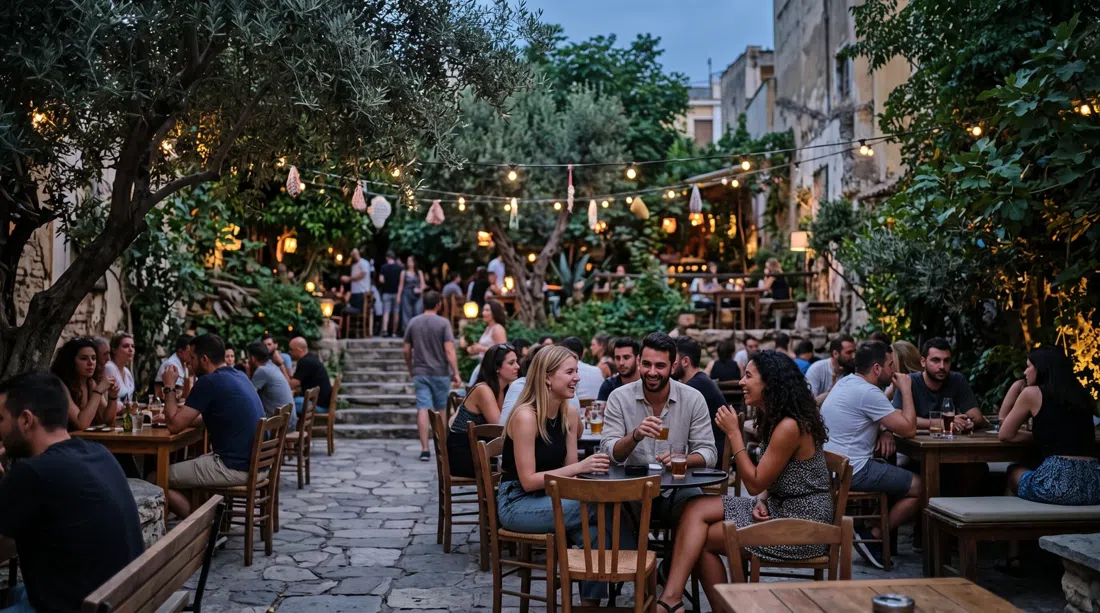
Six d.o.g.s at 6–8 Avramiotou is the best-known of those destinations, and with reason. It is a bar, gig venue and cafe built around a hidden garden, with a strong electronic and live programme and the kind of all-day usefulness that makes it feel like part of the city’s daily infrastructure rather than a one-note club. It is one of Athens’ key rooms for music, and even if you arrive for a drink, you leave with a sense of the neighbourhood’s scale of ambition.
For something more secretive, Cantina Social is the sort of place Psirri does especially well: a backstreet bar tucked under a stoa, with reasonably priced drinks and an eclectic music policy that can move from indie to disco without apology. Half the pleasure is finding the door. The other half is sitting still once you have.
Rebetiko is the third track in Psirri’s nightlife, and in some ways the most local one. These music tavernas and back rooms typically do not get going until 11pm and can run past 2am, fuelled by tsipouro and kefi, that particular Greek social lift that is equal parts mood and momentum. Krasopoulio tou Kokkora belongs to this world, but so does the atmosphere around the square itself. Weekends can get genuinely packed and stay noisy into the early morning, which is either the point or the warning, depending on your priorities.
Things to do / what to see
The best thing to do in Psirri is walk slowly with your head up. That sounds almost too plain for a neighbourhood with this much texture, but the texture is the point. The murals are densest around Sarri and the lanes radiating off Iroon Square, and because the paint changes over the year, the district never quite repeats itself. A return visit is not redundant here; it is the whole idea.
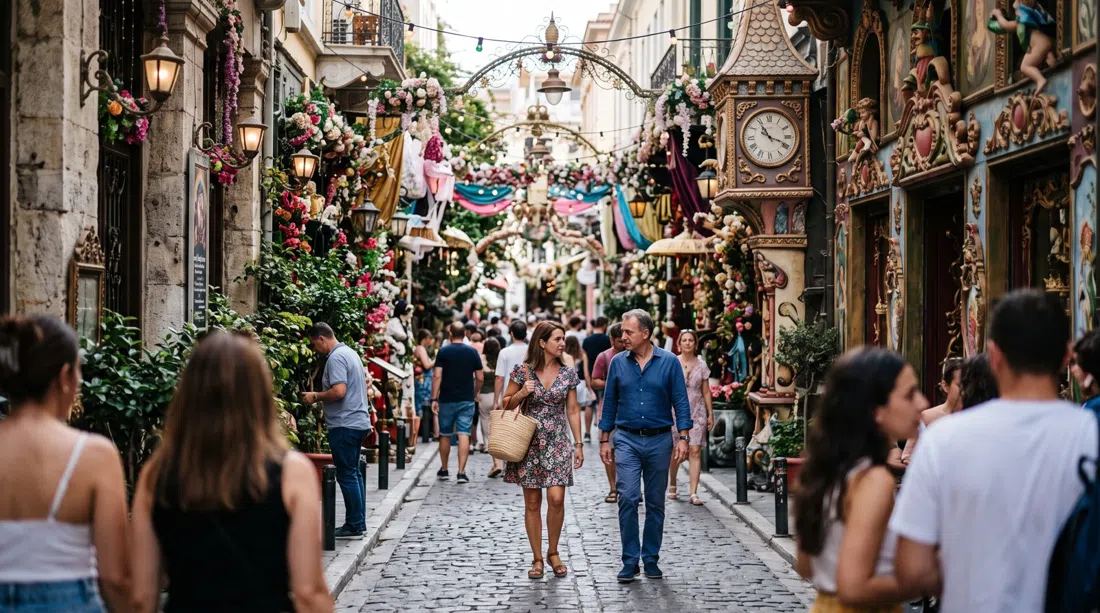
One of the most photographed detours is Pittaki Street, off Ermou, a narrow alley that once gained fame for a canopy of donated lamps and chandeliers created by Imagine the City with design studio Beforelight. The original 2012 installation is no longer permanently overhead, but the street still draws the camera, not least because Little Kook has turned the pavement into a seasonal theatre of excess. Since 2015 it has been re-theming the whole stretch — Alice in Wonderland in summer, a silver-and-red Christmas takeover in winter — with a kind of conviction that is impossible to ignore. Love it or roll your eyes at it, it is unmissable in the literal sense.
Daytime in Psirri is less about monuments than about urban habits. Evripidou is for spice sacks, dried figs, herbs and cured goods; Athinas is for leather, rope and hardware; and the nearby Varvakios Central Market, a short walk up Athinas, is the district’s great covered market, all meat and fish and morning energy. These are not staged attractions. They are the real operating machinery of the area, and they are worth seeing precisely because they are still in use.
Culture is present too, though sometimes in a more conditional way. The Benaki Museum of Islamic Art, in a neoclassical mansion on the Kerameikos edge of the quarter, holds one of the world’s finest Islamic collections, but it closed to the public in late 2024 and reopening has been staggered. Check before you build a plan around it. Even if it is shut, the fact that such a collection sits here tells you something important about Psirri: this is not a neighbourhood that exists only for dinner and drinks. It has layers.
And then there is the geography, which is almost absurdly convenient. The Ancient Agora is about five minutes’ walk away and the Acropolis about fifteen. Psirri lets you do the old stones by day and the late tables by night without changing neighbourhoods. That is a rare kind of urban ease.
Shopping & markets
Psirri’s shopping is not polished retail; it is trade heritage still earning its rent. Evripidou is the sensory headline, a working bazaar of spice, herb and dried-goods sellers where sacks of chilli, oregano, dried figs and cured meats spill onto the pavement. It is the kind of street that makes you slow down whether you intended to or not. Athinas is the spine for hardware, rope and leather, and it still feels like a place where things are made to last. Mompso, the century-old equestrian outfitter, is the emblem here, selling saddles, bridles and handmade leather boots for more than a hundred years.
Pallados brings cookware and traditional vessels into the mix, while smaller independent studios — handmade clothing, accessories, vintage finds, the occasional design shop — have moved into the cheaper workshop units threaded through the quarter. That layer matters because it keeps Psirri from becoming a museum of itself. You can still buy practical things here: spices, olive oil, a leather bag, coffee. You can also browse for the pleasure of seeing a district continue to make and sell rather than merely display.
If you want the fullest market experience, Varvakios Central Market up Athinas is the anchor, and the best time to see it is morning. The scale and noise are part of the appeal, but so is the fact that it sits so close to a neighbourhood defined by eating. Psirri and Varvakios are different rooms in the same house.
Where to stay in Psirri
Staying in Psirri means accepting that the neighbourhood’s best quality is also its most disruptive one: it is alive. The payoff is location. You are a few minutes from Monastiraki metro, the Ancient Agora and the Acropolis, and you are staying inside the food-and-bar action rather than commuting to it. Compared with Plaka, the value is generally better and the feel is grittier, more local, less curated.
The trade-off is noise, especially around Iroon Square and the lanes immediately off it, which can stay loud past 2am on weekends. Light sleepers should look toward the calmer western edge near Thissio and Kerameikos, around Agion Asomaton, or toward the Ermou side, and they should ask for a room off the street. Psirri works best for travellers who want to step out into life rather than retreat from it.
The area’s live hotels are listed directly below.
Getting around
Psirri is small enough that walking is the default and usually the right answer. The main gateway is Monastiraki station, on Line 1 and Line 3, a three- to eight-minute walk from most of the quarter. Thissio sits on the western edge, about eight to twelve minutes away, and is handy if you are approaching from the Kerameikos or Acropolis side. From Monastiraki, Syntagma and the main shopping streets are about 15 minutes by metro, and Line 3 runs directly to Athens International Airport in around 40 minutes with the dedicated airport ticket.
The surfaces matter here. Cobblestones and patched pavements are part of Psirri’s character, but they also mean sensible shoes. At night, a taxi or rideshare makes sense if you are carrying luggage or leaving after the bars empty out, because some lanes are tight and poorly lit once the crowd thins. Within the neighbourhood itself, though, the best transport is still your own feet.
Psirri is not for people who want Athens to whisper. It is for people who like a district that still remembers what it was while insisting on what it has become: a place for meze, music, murals and late nights, with the ancient city only a short walk away.