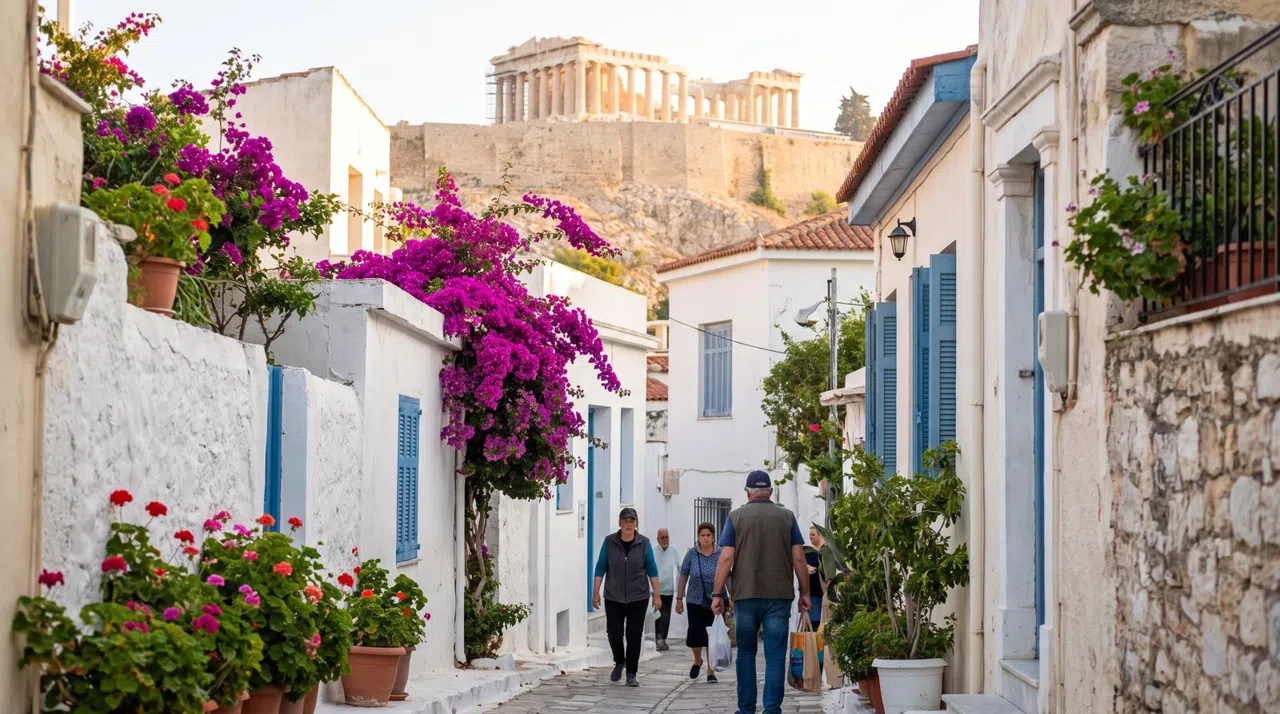
Cut two streets uphill from the souvenir stalls on Adrianou and Plaka changes character entirely: the crowds thin, the noise drops, and you are climbing stepped, cat-patrolled lanes of whitewashed houses that a group of island stonemasons built here in the 1840s. That first shift in register is the whole neighbourhood in miniature. Below, Plaka can feel like the Athens you already know from postcards; above, it becomes something older, quieter and far more peculiar, a place where the city’s oldest inhabited quarter still clings to the Acropolis rock and expects you to walk it properly.
What Plaka is known for
Plaka is two neighbourhoods wearing one postcard. The lower town, around Kydathineon and Adrianou, is the Athens of the guidebook cover: neoclassical façades in ochre and rose, tavernas with waiters angling for your evening, gelato counters, and a slow river of visitors flowing between the Acropolis and Monastiraki. It can tip into theme-park territory, and locals will tell you as much. But keep climbing and the quarter loosens its grip on the obvious. Above the church of Agios Nikolaos Ragavas, the streets narrow into Anafiotika, a pocket of Cycladic-style cottages, blue shutters, potted geraniums and washing lines that looks as though a slice of a small Aegean island was airlifted onto the hillside — which, in a sense, it was.
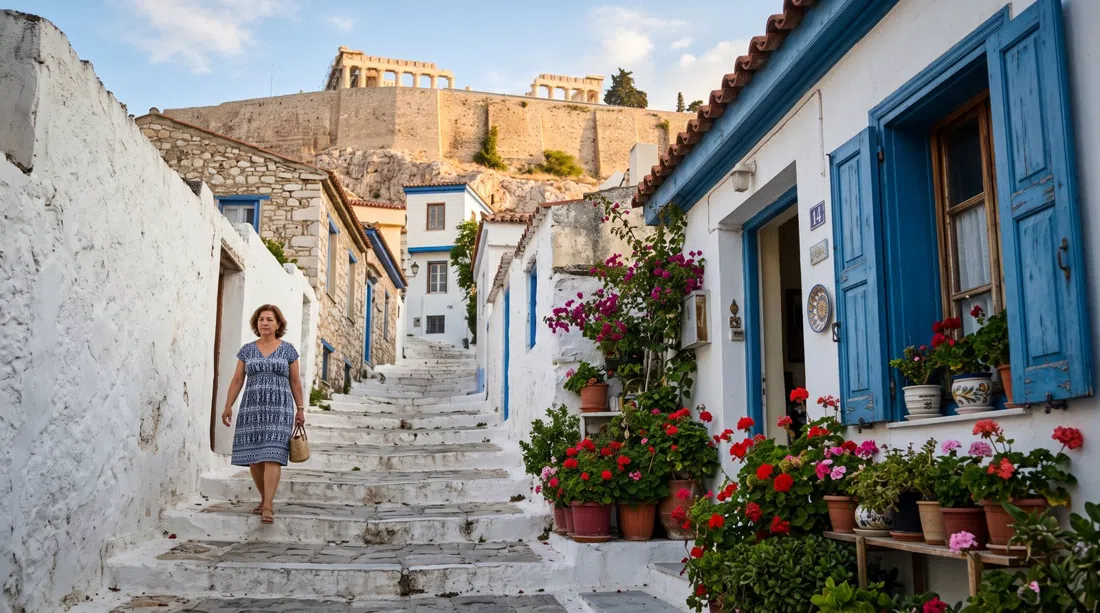
The story behind that little island is one of Athens’s loveliest urban accidents. In the 1840s, builders and stonemasons from the Cycladic island of Anafi came to work on King Otto’s new royal palace and the excavations around the Acropolis. Using an Ottoman-era loophole that said a house raised between sunset and sunrise could not be torn down, they built their cottages overnight and called the settlement Little Anafi. Fewer than fifty of those houses survive, most still owned by descendants of the original families, and the result is not a historical reconstruction but a living fragment of the Aegean set down on a hillside in central Athens.
What holds the two halves together is the sheer density of history underfoot. Roman ruins sit in back gardens. A 4th-century-BC monument anchors a café square. Byzantine churches appear when you least expect them, their domes and brickwork tucked into the pedestrian grid. And because so much of Plaka is traffic-free, you hear your own footsteps as you move from one era to the next. Charming, occasionally too aware of its own charm, and still — genuinely — where Athens keeps its heart.
Where to eat & drink
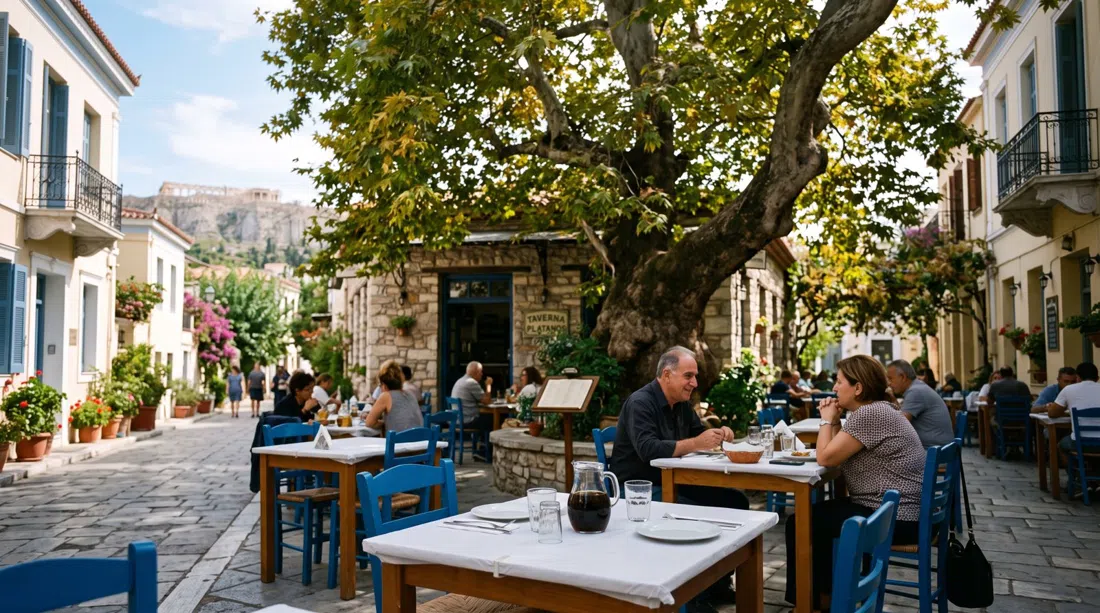
Plaka’s reputation for tourist traps is earned on the main drags, so the first rule is simple: skip anywhere with a tout outside and a laminated photo menu. The second is better: walk uphill, or duck into the squares and side lanes where long-running places have survived by feeding actual regulars. The old-town institution is Taverna Platanos at Diogenous 4, open since 1932, where you eat oven-baked lamb, stuffed tomatoes and pies under a giant plane tree in a quiet square, with house retsina by the carafe and framed portraits of a century of regulars on the walls.
Around the corner, Scholarhio at Tripodon 14 has run since 1935 and works on a wonderfully practical system: a waiter brings a laden tray of the day’s mezedes to your table and you point at what you want. It keeps the bill honest, and it makes lunch feel less like ordering and more like choosing from a family kitchen that has been doing this for generations. For old-Athens atmosphere over an ouzo, O Glykys on the quiet Geronta lane just off Kydathineon square is the kind of kafeneio that still understands shade, woven chairs and small plates of grilled sausage, marinated anchovies and Cretan cheese.
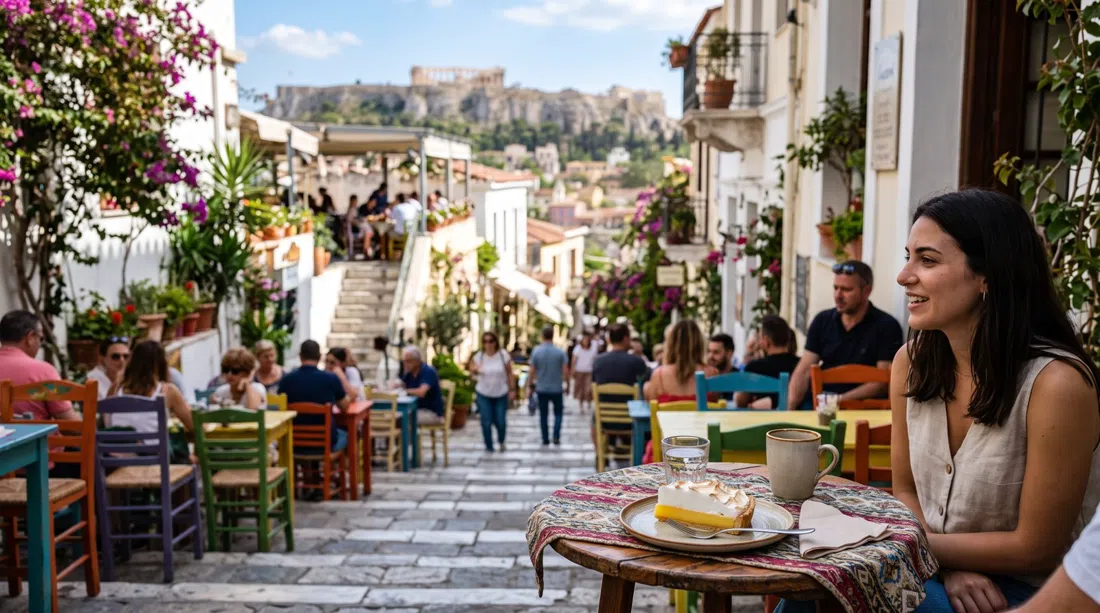
Taverna Saita on Kydathineon is the opposite of polished: a dim, wobbly-tabled basement with a single signature that justifies the descent, bakaliaros skordalia, fried salt cod with a punchy garlic purée. It is the sort of dish that explains why people still come to neighbourhood tavernas even when the city’s tourist centre is only a few minutes away. Up in the car-free upper lanes, coffee becomes the point rather than a pause between more obvious activities. Klepsydra sits on the steps at the edge of Anafiotika, all colourful tables and homemade desserts under the rock, while Yiasemi on the photogenic Mnisikleous steps does a much-photographed lemon pie and pies made on-site each morning, with a rooftop terrace for the view.
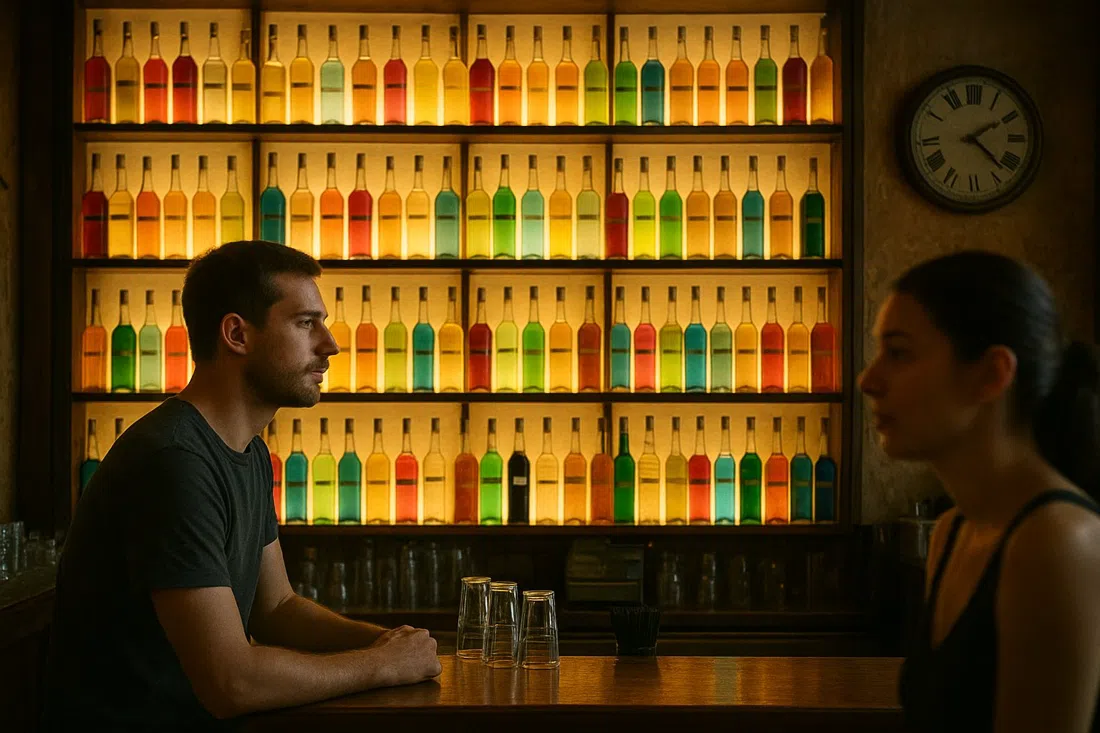
And then there is Brettos on Kydathineon 41, Athens’s oldest distillery, going since 1909. The bar is famous for its backlit wall of rainbow-coloured liqueur and ouzo bottles stacked to the ceiling, and it is one of those places that manages to be both a good drink and a visual event. Order a house-distilled cherry or mastiha liqueur and the evening arranges itself.
Going out
Set your expectations correctly: Plaka is not where Athens goes clubbing. This is a café-and-taverna quarter that winds down by midnight rather than winding up, and that is a large part of why it suits first-timers and older travellers so well. The streets are calm, safe and pleasantly lit, and the whole neighbourhood feels designed for conversation rather than noise.
The single best evening move is Brettos, where the luminous wall of bottles does half the work for you and the drink does the rest. There is something very Plaka about standing there with a house liqueur, watching the backbar glow while the street outside remains almost improbably gentle. Dinner-and-a-carafe evenings at the tavernas on the upper lanes around Platanos and Scholarhio have their own rhythm: conversation, plates arriving in waves, a square settling into itself. It is not nightlife in the modern sense, but it is the kind of night that stays with you.
The most distinctly Athenian night out here, though, is a film. Cine Paris, the rooftop open-air cinema on Kydathineon 22, has floodlit the Acropolis behind its screen since the 1920s. It closed during the pandemic and reopened in 2024 under the Cinobo film platform; screenings run through the warm months from around 19:30, films are shown in the original language with Greek subtitles, and Tuesday and Wednesday tickets are the cheap nights. Even if you do not make it to a screening, just knowing that this cinema exists — with the Acropolis lit up behind it — tells you something about Plaka’s particular confidence in its own setting.
If you want a proper late bar or a club, you are a short walk away in Monastiraki or Psirri. Plenty of visitors never leave Plaka after dark, though, and the quarter is calm and safe to wander at night.
Things to do / what to see
The obvious anchor is the Acropolis itself, whose main approach and ticketed slopes sit directly above Plaka. Most hotels here are a five-to-ten-minute climb from the entrance, which is one reason the neighbourhood works so well as a base: you can be among the ruins before breakfast and back in time for coffee without ever needing transport. But Plaka rewards you at ground level too, and the best days here are the ones in which you resist the urge to rush uphill.
Give a slow morning to Anafiotika, the upper island-village pocket. Get there early to have the whitewashed lanes, blue doors and geranium pots mostly to yourself before the tour groups arrive, and do not try to follow a map; the joy is losing the thread among the steps. The place is small, but it changes your sense of Athens. You are still in the capital, yet the scale, the light and the hush make it feel as if the city has briefly opened a side door to the Aegean.
Down in the lower town, the walled Roman Agora holds the beautifully preserved Tower of the Winds, a first-century-BC octagonal marble timepiece carved with the eight wind gods that doubled as sundial, weather-vane and water clock. It is one of those monuments that looks almost too elegant to have had practical use, until you remember that ancient Athens liked its engineering with a bit of poetry attached.
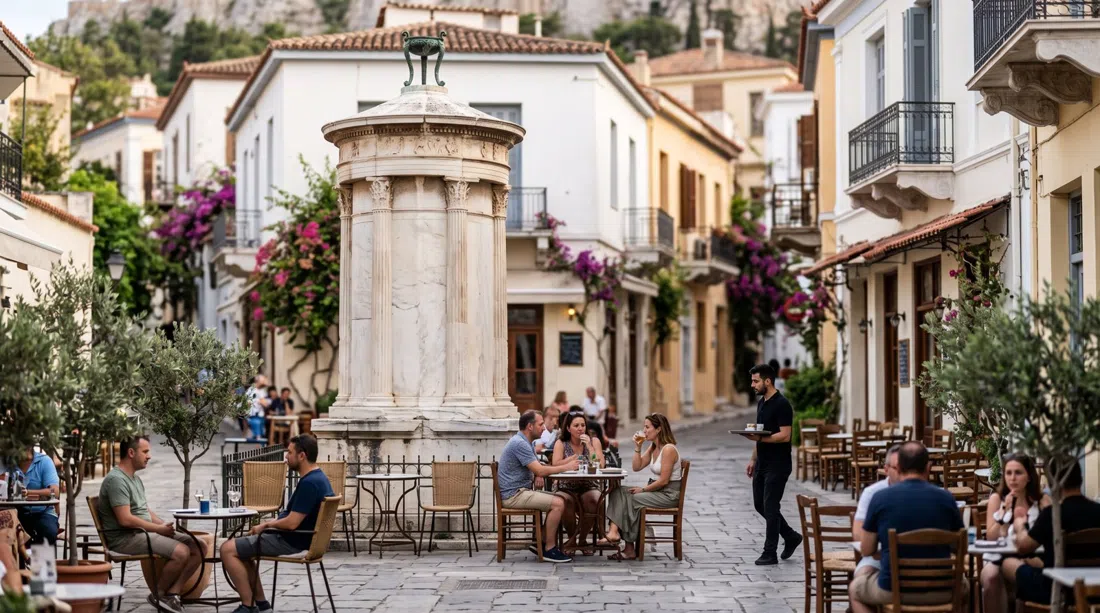
A couple of streets on, the Monument of Lysicrates — a slender columned rotunda from 334 BC commemorating a victory in a choral competition — presides over its own little café square. It is a small thing, but it gives the surrounding lanes a sense of continuity that Plaka does not need to advertise. The past here is not cordoned off into a single monumental axis; it leaks into the everyday.
For quieter, air-conditioned culture, the Kanellopoulos Museum on the north slope holds a superb private collection of antiquities and is rarely crowded. The annexes of the Museum of Modern Greek Culture are scattered through Plaka, including the atmospheric Bath House of the Winds on Kirristou, the last surviving Ottoman-era hammam in the city. Between the two, the walk along the pedestrian Dionysiou Areopagitou promenade, which skirts Plaka’s southern edge below the Acropolis and passes the Odeon of Herodes Atticus and the Acropolis Museum, is one of the finest strolls in Athens.
Shopping
Plaka’s lower streets, especially Adrianou and Pandrossou at the Monastiraki end, are wall-to-wall souvenirs — evil-eye trinkets, worry beads, olive-oil soap, fridge magnets and a great deal of mass-made filler. That is the surface layer, and it is thick enough to make some visitors give up quickly. But if you filter hard, there is genuine craft to be found.
The name to know is Melissinos Art — The Poet Sandal-Maker, the workshop that revived handmade ancient-Greek leather sandals in the 1950s and once shod the Beatles, Sophia Loren and Maria Callas; now run by Pantelis Melissinos, it still cuts and fits pairs to your feet from good Cretan leather, a world away from the €10 tourist versions. It is the sort of place that reminds you Plaka is not merely a shopping district but a working neighbourhood with a few fiercely specific traditions still intact.
Brettos doubles as a shop, so you can carry off a bottle of its own cherry or mastiha liqueur straight from the distillery. Beyond footwear, look for real Greek buys rather than airport tat: cold-pressed olive oil, wild-mountain herbs and Greek mountain tea, mastiha products from Chios, small-batch ouzo and tsipouro, and worry-bead shops that treat the beads as a serious craft. For everyday browsing, the shaded lanes below Anafiotika are pleasant to potter through, and Plaka runs seamlessly into the flea-market sprawl of Monastiraki to the west if you want antiques, vinyl and bric-a-brac.
Where to stay in Plaka
Plaka is the classic first-timer’s base in Athens, and for good reason: you can walk to the Acropolis, the Acropolis Museum, the Roman Agora, Syntagma and Monastiraki without ever taking transport, and the lanes are pedestrian, safe and quiet at night. The choice is really about how much street life you want at your door.
The lower streets around Kydathineon and Adrianou put you in the thick of the tavernas and shops, which is handy if you want to step out for dinner and a drink without thinking about it. The trade-off is that these blocks can be busy and, in a few spots, noisy from evening diners. For calm, aim higher and to the edges — the streets climbing toward Anafiotika, or the quieter blocks toward Syntagma around Nikodimou. That is where the neighbourhood feels most like a place people actually live, rather than a stage set for day-trippers.
Stock here runs from small family-run guesthouses and boutique hotels in restored neoclassical houses up to grand five-stars: the neoclassical Electra Palace Athens on Nikodimou, with its Acropolis-view rooftop and pool, is the landmark upscale choice, while the pedestrian southern promenade shelters design hotels with Parthenon views. Overall the price feel is mid-range to upmarket — this is a premium address and you pay for the location and the views — with a handful of budget guesthouses tucked up the hill. Book early for spring and autumn, when Athens is at its best and Plaka fills fast.
Getting around
Plaka is small, entirely walkable and largely pedestrian, so you will use your feet more than any train. Three metro stations ring the quarter: Monastiraki on the northwest edge, Syntagma to the east and Akropoli to the south — from any of them it is a three-to-ten-minute walk into the lanes depending on where you are headed. Nowhere in central Athens is far: Syntagma Square, the National Garden, Monastiraki’s flea market and the Acropolis entrance are all within 10–15 minutes on foot.
Getting here from the airport is easy and cheap. Take Metro Line 3, the blue line, direct to Syntagma or Monastiraki, roughly 40 minutes with trains about every half hour, then walk in. For Akropoli, change at Syntagma onto the M2 red line. A taxi from the airport is a flat metered fare and useful if you are arriving with heavy bags, since the final approach to most Plaka hotels is stepped and car-free.
One practical note matters more than any map app: those pretty stepped lanes mean wheeled suitcases and limited mobility can be a real challenge in the upper streets, so check exactly where your hotel sits before you book. Plaka is a neighbourhood to be walked, not driven, and that is part of its appeal. It is also why the best way to understand it is to start low, keep climbing, and notice how quickly the city changes once the souvenir stalls fall away.