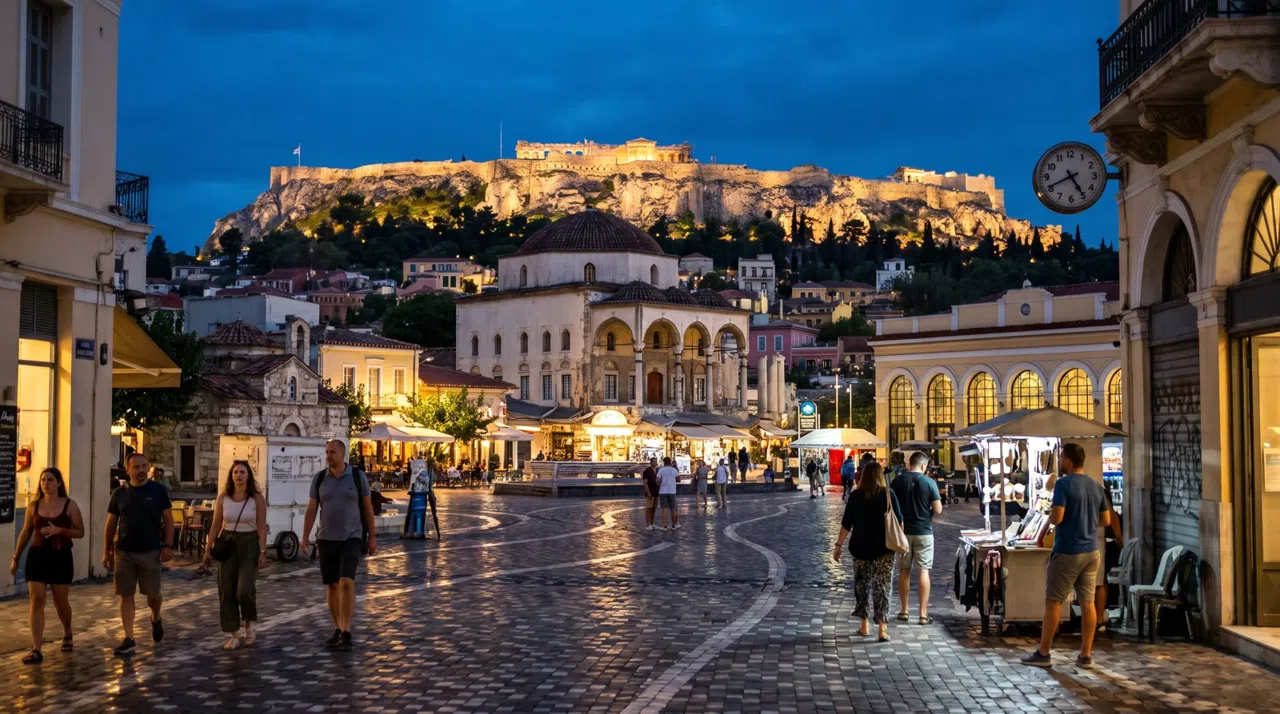
Come out of the Monastiraki metro and the whole city hits you at once: a bouzouki busker over by the fountain, charcoal smoke drifting off the souvlaki grills on Mitropoleos, a preacher on a crate, and the Acropolis lit up over the rooftops like a stage set nobody bothered to take down. This is Athens with the volume turned up — a market, a metro junction and 2,500 years of ruins jammed into a few noisy, thrilling blocks.
What Monastiraki is known for
Monastiraki behaves like a crossroads because it has always been one. The square is a collage of eras, each one refusing to leave. The tiny Pantanassa church — the “little monastery” that gave the district its name — sits in the middle of the churn, while the pink-domed Tzistarakis Mosque from 1759 keeps watch nearby. Underfoot, the excavated bed of the ancient Eridanos river shows through the metro station floor, a reminder that even the transit system here doubles as archaeology. And above it all, the Acropolis floats over the rooftops, visible from almost every angle, as if the city has arranged its own backdrop and then gone on living in front of it.
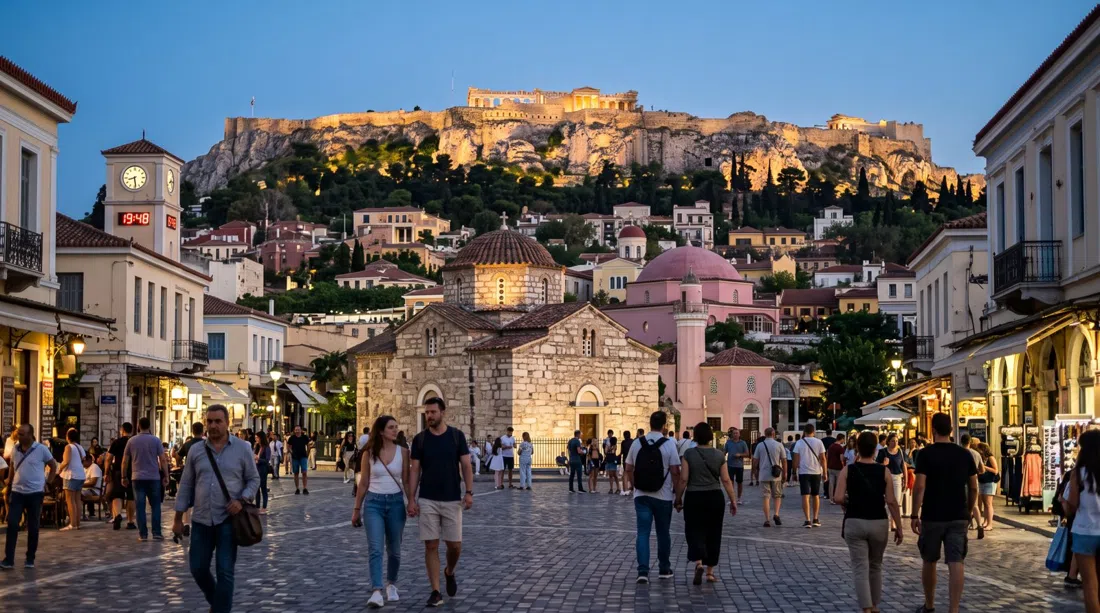
The square’s real pulse, though, comes from the market streets radiating away from it. Ifestou, Pandrossou and the lanes around Avissinias Square are the district’s working engine: a permanent daily sprawl of antique dealers, sandal-makers, record shops and souvenir stalls, all of it spilling into the street as if the storefronts simply gave up on walls. On Sundays, Avissinias turns into a full open-air antiques market, and the whole area shifts into a different register: more serious browsers, more private sellers, more crates and old maps and enamel signs laid out on the pavement. Get there before 10am if you want to see it with some breathing room; by early afternoon, the market starts folding itself away.
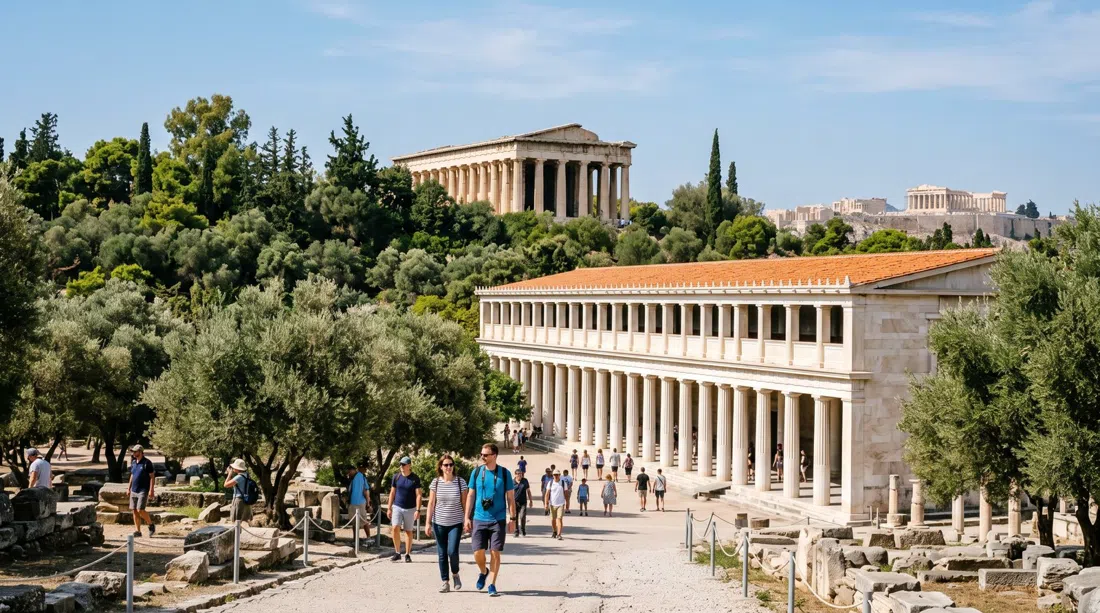
What makes Monastiraki compelling is not just that it contains ruins. It contains ruins that are still part of daily life. The Ancient Agora, where Socrates argued and the democracy did its business, sits just west off Adrianou Street, crowned by the Temple of Hephaestus, the best-preserved Doric temple in Greece, its columns almost fully intact. On the square’s eastern edge are the ruins of Hadrian’s Library, the Roman emperor’s 2nd-century reading complex. You can stand among the remains, hear a busker tuning up nearby, and then buy a gyro before you’ve even finished your thought. That collision — sacred, civic, commercial, hungry — is the neighbourhood’s whole personality.
Where to eat & drink
Monastiraki is souvlaki ground zero, and the rivalry plays out on one stretch of Mitropoleos with the confidence of a local feud that has outlived several generations of customers. O Thanasis, at Mitropoleos 69, has been grilling since the 1960s and is the pilgrimage stop: kebab — spiced minced-meat patties — wrapped in warm pita with tomato, onion and a fistful of parsley, eaten at a packed pavement table for a few euros. It is the sort of place that makes a street corner feel like a civic institution.
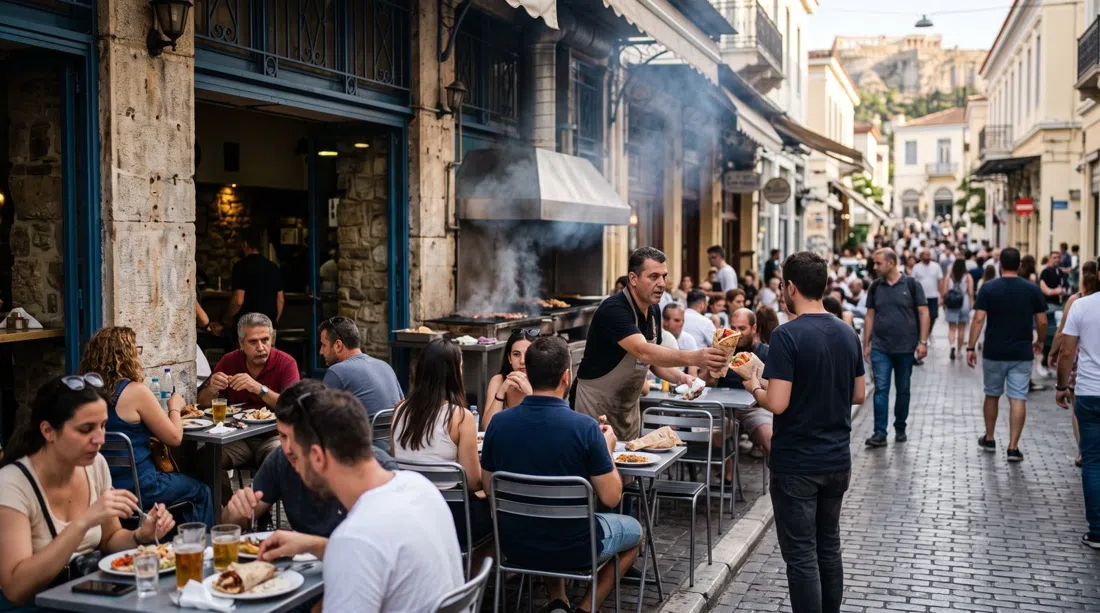
A few doors down, Bairaktaris on the square itself has been going since 1879 and leans into the old-school taverna mood: big plates of pork gyros, chips and tzatziki, the kind of meal that lands with the certainty of something Athens has been doing forever. If you prefer your pilgrimage stripped down to the bone, head to Kostas on nearby Agia Irini Square. It is a tiny purist’s kiosk that does one thing — a small, perfect charcoal pork souvlaki with a smear of yoghurt and paprika — for about €3.50, and it often sells out by mid-afternoon. A few steps away, Hoocut takes the same idea and modernises it without losing the point: five chefs, house-milled pita, an own butcher and bakery, souvlaki treated with a seriousness that feels almost architectural.
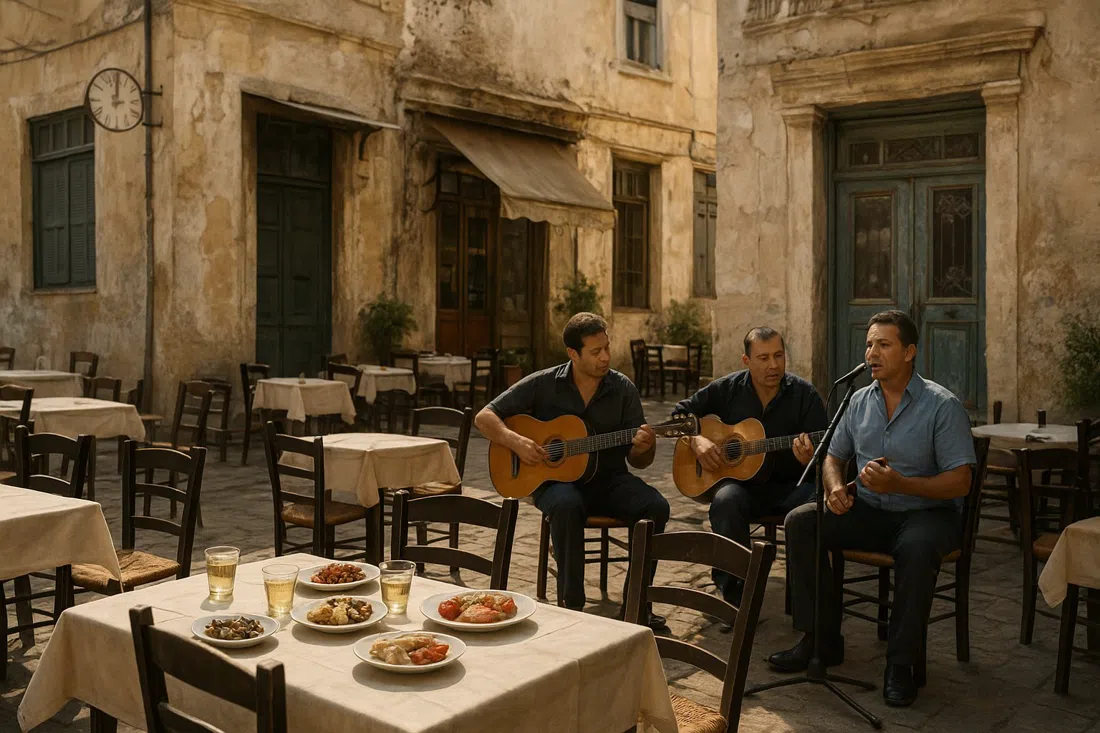
For a proper sit-down meal, the tavernas along Adrianou trade on the neighbourhood’s two great luxuries: modern-Greek cooking and a view. Kuzina is one of the names that comes up most often for that combination, and Diodos belongs to the same riverside of tables where the Ancient Agora and Acropolis do half the decorating. But if you want the old Athens mood to settle around you, Cafe Avissinia is the place to aim for. Tucked into the flea-market square at Kynetou 7, it layers meze, retsina and weekend live rebetika into something that feels less like dinner than a remembered version of the city.
At the top end of the neighbourhood spectrum, The Zillers Rooftop at Mitropoleos 54 holds a Michelin star for chef Vasilis Roussos’s Greek tasting menus, served on a terrace staring straight at the Parthenon. It is a sharp reminder that Monastiraki can move from pavement grill to fine dining in the space of a short uphill walk. And when you need something sweet after all that salt and smoke, Lukumades on Aiolou nearby does hot loukoumades — honey-and-cinnamon doughnut balls — that make a persuasive case for lingering a little longer before you drift back into the square.
Going out
After dark, Monastiraki tilts upward. The neighbourhood is basically a stack of Acropolis-view rooftops, each one competing for the same sky. The classic move is A for Athens, the 7th-floor bar on the boutique hotel right on the square. Its terrace points straight at the floodlit Acropolis, and at sunset it fills with the kind of crowd that understands the value of a view and is willing to queue for it. Go early if you want a seat; otherwise the ritual becomes part of the evening.
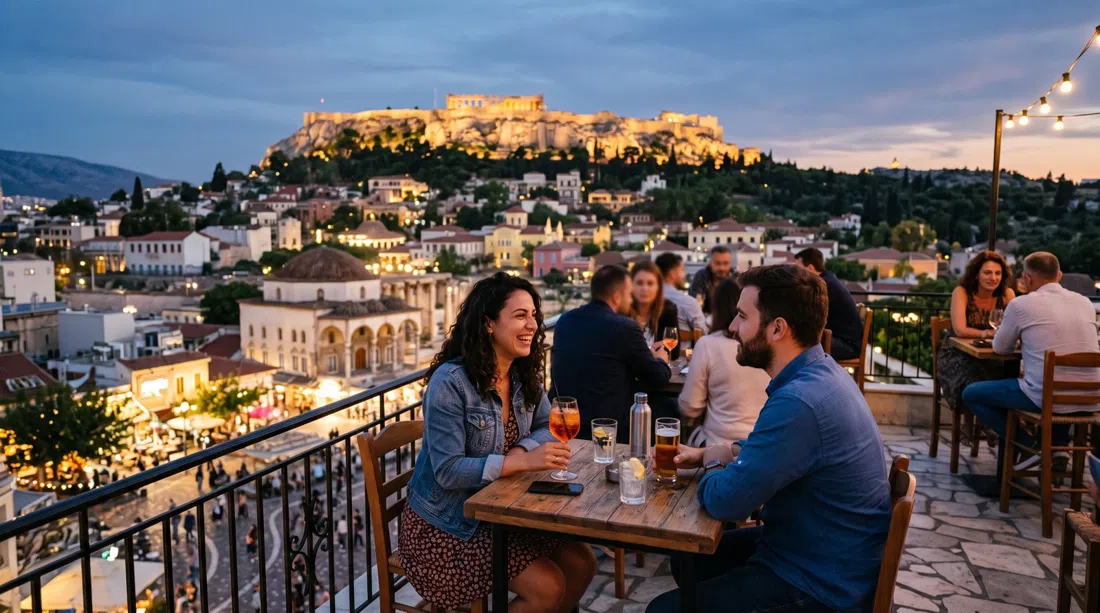
If you want a broader sweep, 360 Cocktail Bar at Ifaistou 2 rises above the square’s western corner and opens the panorama even further, pairing city-and-Acropolis views with cocktails and small plates until the small hours. Hidden in the alleys just off Ermou, Couleur Locale at Normanou 3 spreads over two upper floors and a rooftop terrace where the view improves as you climb, and where DJ nights carry the evening well past the point where the square below has become a blur of headlights and voices. At ground level, TAF – The Art Foundation at Normanou 5 is the cooler, more contemplative option: a gallery and courtyard bar in a 19th-century Ottoman house, good for coffee by day and cocktails to a jazz-and-funk soundtrack at night.
Then there is Klakaz on Avramiotou, the reborn 2026 version of the beloved six d.o.g.s courtyard. It keeps the street’s music tradition alive as an all-day café-bar-and-concert space, which feels entirely right for a neighbourhood that has never separated nightlife from public life in the first place. One honest note about the rooftops: you pay a premium for the view, so most locals do the sunset drink upstairs and the real eating downstairs, at street level, where the grills are.
Things to do
The set-piece is the Ancient Agora, entering off Adrianou, and it is worth giving it real time rather than treating it as a checkbox between coffees. This is a green, ruin-strewn expanse where you can walk the ground of the classical city, climb to the intact Temple of Hephaestus, and duck into the reconstructed Stoa of Attalos, now a museum of finds from the site. It opens roughly 8am–8pm in summer and to 5pm in winter; since the old combined multi-site ticket was discontinued in April 2025, you now buy a separate entry, about €10 in summer. The scale is humane. You are close enough to the street to hear the city, but the stones still create their own weather.
On the square’s edge, Hadrian’s Library is a quick, cheap add-on for a fifteen-minute reset among broken columns. It is the kind of stop that works best when you are already walking through Monastiraki and simply let the ruins interrupt you. The Monastiraki Flea Market is the other essential. Its daily lanes along Ifestou, Pandrossou and around Avissinias are free to wander and always changing in detail, even if the overall mood remains gloriously the same: copperware, army surplus, old vinyl, ceramics, sandals, icons, spice blends, the whole grammar of the city’s informal commerce.
The pedestrianised stretch of Adrianou beside the Agora is the slower version of the same neighbourhood, lined with cafés under the ruins and made for a long, unhurried afternoon. If you want a prettier climb, the Anafiotika hamlet of whitewashed Cycladic cottages on the Acropolis slope sits just above the neighbourhood through Plaka, a short walk that changes the scale of the city entirely. And back above the flea-market square, the courtyard of TAF doubles as an ever-changing contemporary art space worth checking between exhibitions, because Monastiraki is at its best when it refuses to stay in one category for long.
Shopping & markets
This is shopping-as-sport Athens, and it splits cleanly by street. Ifestou — Hephaestus Street — is the raw spine of the flea market, where copper and brass lanterns hang beside worn leather jackets, army surplus, band tees, worry beads and crate after crate of second-hand vinyl. It is not polished, and that is the point. The hard sell is part of the theatre here, and the theatre is part of what makes the street feel alive rather than merely commercial.
Pandrossou, curving toward Plaka, is the souvenir artery: ceramics, olive-wood spoons and bowls, spice blends, icons and endless leather sandals. A bit of polite haggling is expected on anything without a fixed price, but the street also rewards a slower eye. The best purchases are often the ones that look ordinary until you realise how long they have been sitting in the sun.
For the real thing, the Melissinos workshop on Normanou 7 has been hand-cutting leather sandals since the family started in the 1920s. The story carries its own mythology — the “poet sandal-maker” who once shod the Beatles and Jackie Onassis — but the appeal is practical as much as romantic. Pairs are made and adjusted to your feet on the spot, which is exactly the sort of old-world service that still feels miraculous in a neighbourhood otherwise built on noise and motion.
Around Avissinias Square, the permanent antique dealers are the serious end of the market: vintage cameras, enamel signs, chandeliers, old maps and furniture, at their fullest on Sunday when private sellers lay goods out on the pavements. The rule of thumb across all of it is simple: carry small cash, start well below the asking price on stalls, and treat the fixed-price shops — and the sandal workshops — as fixed-price. In Monastiraki, shopping is less about buying the perfect thing than about being pulled into the city’s ongoing argument with itself over what is worth keeping.
Where to stay in Monastiraki
Staying in Monastiraki puts the Acropolis, the Agora, the Plaka lanes and the metro on your doorstep. You can walk to almost everything in the old city and roll off the airport train at your hotel door, which is a rare kind of convenience in Athens. The trade-off is noise: the square, the buskers and the rooftop bars run loud and late, especially from Thursday to Saturday, so anything facing Monastiraki Square, Ifestou or Ermou is exciting but not restful. That makes it a strong fit for younger travellers, short-stay city-breakers and anyone who plans to be out until late anyway.
For the same central position with a calmer night, aim for a hotel on a side street off the square, or step just over the edge into quieter Plaka or leafy Thissio, both a few minutes’ walk away and much gentler after dark. Expect mostly small boutique hotels and design-led rooftops, plus a strong hostel scene rather than big chains. The overall price feel is mid-range, with genuine budget beds easy to find. Bring earplugs if you’re square-side.
Getting around
Monastiraki is a transport hub as much as a neighbourhood. The Monastiraki metro station, right under the square, is where Line 1 — the green old ISAP line to Piraeus port and the northern suburbs — crosses Line 3, which runs direct to Athens International Airport in about 40 minutes. A dedicated airport metro fare of €9 one-way applies, versus €1.20 on the standard network, which makes the station unusually useful even by central-Athens standards. Syntagma is one stop or a five-minute walk east along pedestrianised Ermou.
Almost everything you want is on foot: the Acropolis entrance is about a 12–15 minute walk, largely uphill via the Areopagitou promenade; the Acropolis Museum and Plaka are 10–15 minutes away; the Ancient Agora is quite literally next door. The catch is that the flea-market lanes are narrow, cobbled and often stepped, and they jam at midday and on Sundays, so they are no use for wheeled luggage or strollers. Time arrivals for early morning if you can. Taxis and ride-hail are easy to grab on Ermou or the square’s edges, with Uber dispatching licensed taxis here.
Monastiraki is rarely quiet, and that is part of its appeal. It is a neighbourhood that lets you buy a pair of sandals, eat a perfect souvlaki, stand in front of Roman ruins and end the night with an Acropolis view, all without changing shoes or mood. Athens doesn’t get more concentrated than this.